


“There is no limit in the sensitivity of our hands, but if we think we are good enough, we can never progress.”
Jean-Pierre Barral (D.O. mRO-F)
:: Organs ::
:: Nerves / CNS / PNS ::
:: Arteries ::
:: Joints / Muscles / Ligaments / Capsules / Synovio-Lymphatics ::
:: Brain :: Emotion ::
-
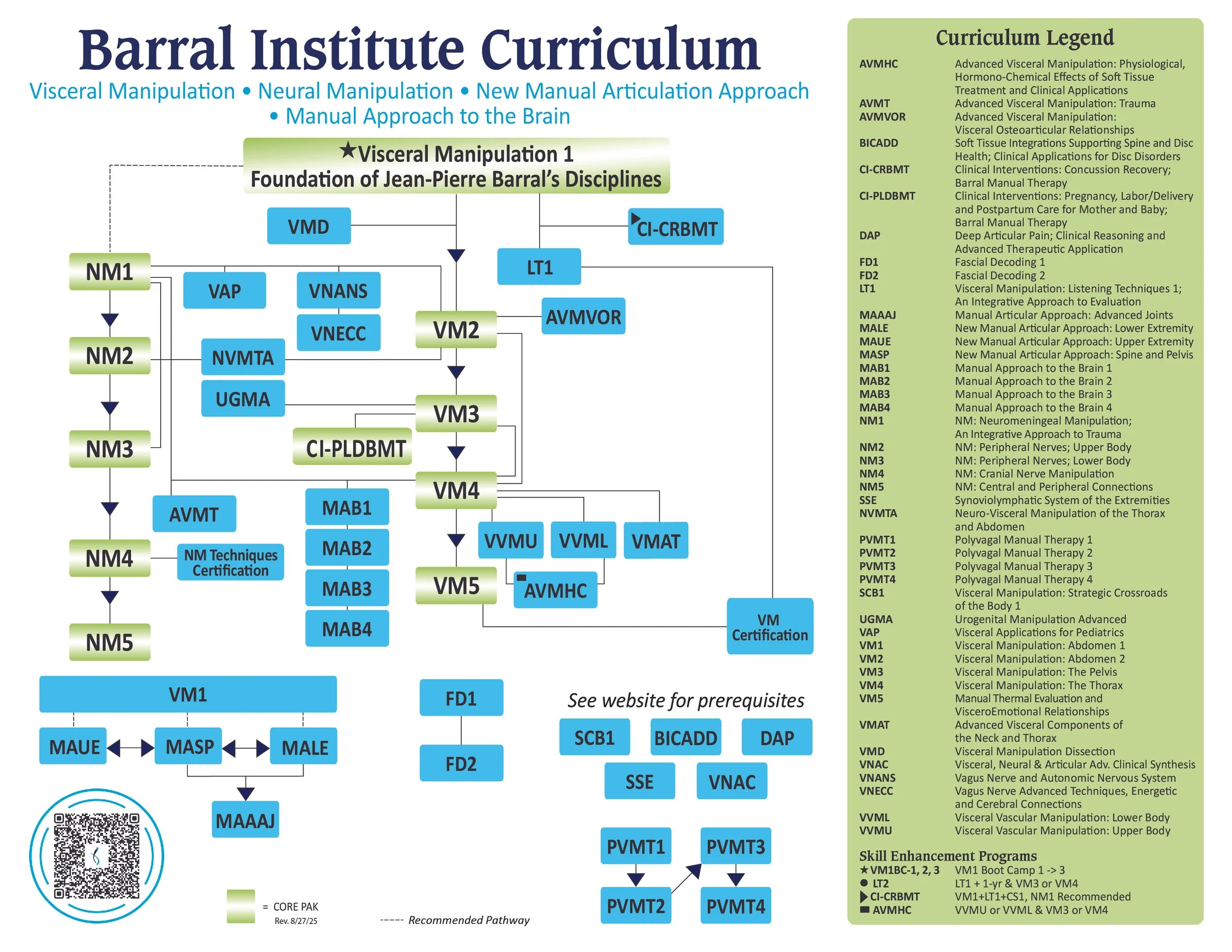
Through extensive clinical work on viscera, Jean-Pierre Barral developed manual techniques to restore organs’ mobility & motility, by working on (parenchyma) and around organs (their ligamentous system), so as to improve proprioceptive communication within the body, hence minimize any structural and physiological dysfunctions due to organs’ undesirable mobility/motility. Visceral Manipulation (VM) expands from 1 to 5 as follows:
Abdomen 1: Intra-peritoneal organs
Abdomen 2: More Intra & Retro-peritoneal organs
Pelvis: Organs within pelvic cavity, uro-genital organs
Thorax: Organs within thoracic cavity, & cervical spine
Emotional assessment: Manual Thermal Evaluation & Emotional treatment: Viscero-Emotional Relationships
-
Listening Techniques’ (LT) are manual assessment tools developed by Jean-Pierre Barral, to enable the practitioner to determine the primary causes of a patient’s dysfunctional pattern, and to understand the anatomical relationship of the two.
Whatever modalities a practitioner use, LT enhances the evaluation skills. There are 2 levels of LT courses as follows:
An integrative approach to Evaluation (LT1)
Demonstrate through ”listening”, which body structures are involved and which one is primary, and how to interpret the information from listening, with regard to the body’s imbalances, in terms of anatomical and physiological relationships;
Ways to enhance practitioners’ sensitivity of their hands and to be certain about their listening results, so as to increase treatment effectiveness;
How to incorporate "listening skills" in the patient’s evaluation and treatment plan.
2. An Advanced Evaluation Approach to Total Body Systems (LT2)
Focused Listening on the brain, nerves, vascular system and articulations, the connections and understanding of all these systems.
Deepen "listening techniques” to enhance assessment and treatment precision.
Both courses include lecture, demonstration and practice for each technique presented.
-
Neural-meningeal Manipulation (NM) curriculum is developed by Jean-Pierre Barral and Alain Croibier (D.O.) with clinical results plus scientific information support.
Nerves must be free to move / glide with regard to their surrounding connective tissues e.g. muscles, fascia, membranes, organs, bones, to deliver optimal function. This is the principle of NM, which contains techniques in resuming free movement of a nerve with respect to its nearby extra- neural tissues and normalizing the pressure within intra-neural tissues.
Correct neural signal is sent to the Central nervous system (CNS) only when the nerve can freely glide/move within the body while one performs certain voluntary movements. Complete free movement of a nerve is necessary for proper 1) nerve & electromagnetic conduction, 2) intra-neural blood & nervous supply, 3) local & systemic response, thus to improve functions of structures innervated by the nerve.
NM curriculum includes:
A specialized course focusing on trauma & whiplash, assessing & treating neural-cranium, facial-cranium, and dural tube tension.
Explores assessment and treatment techniques for peripheral nerves of the upper body.
Explores assessment and treatment techniques for peripheral nerves of the lower body.
Explores assessment and treatment techniques for nerves of the brain and cranial region.
Expands on techniques practised from NM1 to NM4, with more elaboration and skill refinements on many parts of CNS and PNS. Topics covered include the olfactory nerve, more about the vagus nerve and the pudendal nerve.
-
Explores assessments and treatment techniques of the vascular system, through in-depth review on the anatomy and physiology of the vascular system:
How arteries dilate / diminish in diameter would impose an effect on the body and vice versa;
How compression along vascular structures creates restriction patterns and pain;
How to locate and release restrictions along the vascular structures;
Enhance your understanding of how increased blood circulation to an organ improves its function, and learn how to improve circulation to the organs, directly and/or indirectly;
Discover the research done with Doppler ultrasound to determine the best mobilizations of the arteries to improve local and general blood circulation;
Learn practical integration of vascular treatment into the therapeutic session.
This curriculum consists of 2 levels, Viscero-Vascular Manipulation for Upper Body (VVMU) and Viscero-Vascular Manipulation for Lower Body (VVML), each covers the above topics with each course’ focuses differ in terms of anatomical classification. VVMU covers vasculature above the diaphragm (aorta, common carotid arteries, pulmonary, subclavian arteries etc); VVML covers vasculature below the diaphragm (hepatic, splenic, superior mesenteric arteries, common iliac arteries, femoral and popliteal arteries).
-
This curriculum integrates all aspects of the joint including the nerve, artery, bone, capsule, and ligaments, as well as visceral and emotional connections. The relationship between the viscera and the joints is explored as the two are interconnected, without addressing the two, a joint problem cannot be fully resolved. This curriculum equips practitioners to understand the interactions of the joints with the body to help restore proper function.
This curriculum includes courses with focuses on the nerve, arteries, menisci, ligaments capsules of the joints; how the joints receive and emit messages with other parts of the body, and its emotional connections. How can practitioners evaluate and treat each major joint for its primary dysfunction from the anatomical or physiological systems that contribute to it.
Courses are categorized in anatomical manner as:
Manual Articular approach of Upper Extremities (MAUE) which focuses on the joints of upper limb i.e. shoulder complex, elbows and wrists;
Manual Articular approach of Lower Extremities (MALE) which focuses on the joints of lower limb i.e. hips, knees, ankles, feet;
Manual Articular approach of Spine & Pelvis (MASP) which focuses on the whole vertebral spinal column and joints of pelvis;
Alain Croibier (D.O.) developed another 2 courses: Manual Articular Approach: Advanced Joints (MAAAJ) & Deep Articular Pain; Clinical Reasoning & Advanced Therapeutic Application (DAP), which are the advanced level of learning of previous 3 articular courses, with more in-depth learning on anatomy, biomechanics, the visceral & nervous system influence on joints, and understanding of articular pain and its clinical complexity.
Barral & Croibier both advocated the importance of ultra-precision in assessment & treatment that facilitates the most lasting therapeutic effect for the patient. This precision requires great anatomical and topographic knowledge, which would be emphasized in these 2 courses.
Jean-Pierre Barral (D.O., founder of VM)’s newest developed course: Synovio-lymphatic System of the Extremities (SSE) is another course providing techniques on articular aspects. In covers joint issues due to mechanical, inflammatory, and immune attacks, by assessing and treating neuro-circulatory and lymphatic functions to aid in recovery. Listening on synovial & lymphatic fluids is the focus of this course.
-
With over 40 years of practice, study and explorations on patients with head trauma, stroke, brain / neuro-degenerative diseases, and psychomotor disabilities, Jean-Pierre has developed techniques to address the brain: the “content”, includes associated neocortex, nervous and vascular connections; and “container” , includes its bony and membranous structures.
The course is organized into two parts:
The structural approach is aimed at the vascular, nervous, meningeal, ocular, barometric, and cerebrospinal fluid circulation systems.
The functional approach explores the sense of smell, hearing, sight, language, coordination, proprioception, emotions, etc.
This curriculum assists manual therapy practitioners to view the manual approach for systemic diseases e.g. Parkinson’s disease, Alzheimer’s disease, and Multiple Sclerosis with a new perspective. Such pathologies and the limitations of manual therapy with regards to helping people with these conditions will be discussed, and how Barral’s work may transcend these limitations and help alleviate patients’ symptoms due to these diseases. Barral shares how precise manual therapy may encourage the central nervous system to self-repair and thus may help people with certain conditions. The practitioner will also learn ways to help people who have had a stroke or ictus.
In Barral's own words, to help restore 'inner bridges' within the brain, which is vital to the life of those facing difficulties.
This curriculum has 4 levels, namely MAB1 to MAB4, with one course built upon the previous one with a deeper understanding on the pathologies of certain diseases and more refined way to treat the brain - its structural and functional parts, to bring in more possibilities for patients of such.
-
On top of the above courses from distinctive systems of the body, Barral also developed several advanced VM courses, which are built upon a solid foundation of VM, NM, Vascular & Articular approaches, these include:
Advanced Visceral Manipulation: Physiological and Neuroendocrine Effects of Soft Tissue Treatment and Clinical Applications (AVMHC) - study how very precise VM techniques facilitate local and central neuroendocrine reactions & the relationships between viscera & vagus nerve.
Advanced Visceral Manipulation: Visceral Osteoarticular Relationships (AVMVOR) - study the influences between the visceral system & osteoarticular system, and how to locate the underlying causes that could be visceral origin of a structural issue and the new treatment approach.
Advanced Visceral Manipulation: Trauma (AVMT) - an integrated approach on assessment and treatment on visceral, neural, vascular aspects through thorough understanding on effects on the body after collisional forces from trauma, with further consideration of the heterogenous elements of body (liquid & solid) respond to the shocks received.
Clinical Applications for Disc Disorders; Soft Tissue Applications (BICADD) - advanced study on intervertebral discs in terms of anatomy, biomechanics and its visceral influence, with teaching on more refined listening, assessment & treatment skills.
The above is not an exhuastive list, for more advanced course inquiries, please feel free to write to us.